
Pike County Multi-Day Arrest Log
For real depth, start with the official Pike County Inmates feed. It works as the county's practical arrest log. The feed has held well over a hundred entries, reaching back across multiple years, with the newest bookings listed first. Depth varies over time. The roster does not promise that entries stay up forever, and a listed name does not always mean someone is still in custody.
There is no separate 72-hour or seven-day Pike County blotter. The roster goes deeper than either label would suggest. Booking cards come from the Pike County Sheriff's Office, Troy Police Department, Brundidge Police Department, ALEA, and other agencies mixed together. Filter by your dates. Then check the release channel and the court record. For a strictly same-day question, the 24 Hour Arrests page is the better route.
Read the Pike County Blotter
Go to the Sheriff first. A newspaper or aggregator should never be the starting point. A multi-day arrest search works backward from what you know. That usually means an approximate date, a full name, the arresting agency, or a booking number. From there, follow the event forward. Custody ends with a release, and the case then belongs to the court.
- Open the Pike County Sheriff website and choose the Inmate Roster.
- Locate the likely date range in the newest-first list. Do not assume all displayed entries fall within one week.
- Compare the booking number, date and time, arrest agency, charge descriptions, and bond fields.
- Check the Sheriff Released feed when the person may no longer be held.
- Use the arresting agency for its incident report and the Pike County court for the eventual case result.
Keep two records straight. The roster entry is not the incident report. A Troy or Brundidge officer may hold the full narrative, while Pike County Jail holds only the booking card. A court file can later show a dismissal, an amendment, diversion, or another outcome the original entry never reflects.
Pike County Arrest-Log Fields
The roster carries plenty of fields. Each line still has limits. Read the source label and the timestamp before drawing any conclusion from it.
| Log field | How to interpret it |
|---|---|
| Person name | The booking identity label; confirm with other details when names are similar. |
| Booking number | The Pike jail system’s event identifier. |
| Date and time | The intake timestamp, not necessarily the time of the alleged incident. |
| Arrest agency | The agency credited in the booking export. |
| Charges | Charges entered during booking, subject to later court change. |
| Bond | An amount when supplied; a blank does not establish release eligibility. |
| Photo and descriptors | A booking-system image when present plus age and physical fields. |
The official same-day and multi-day feed view demonstrates the combined booking export:
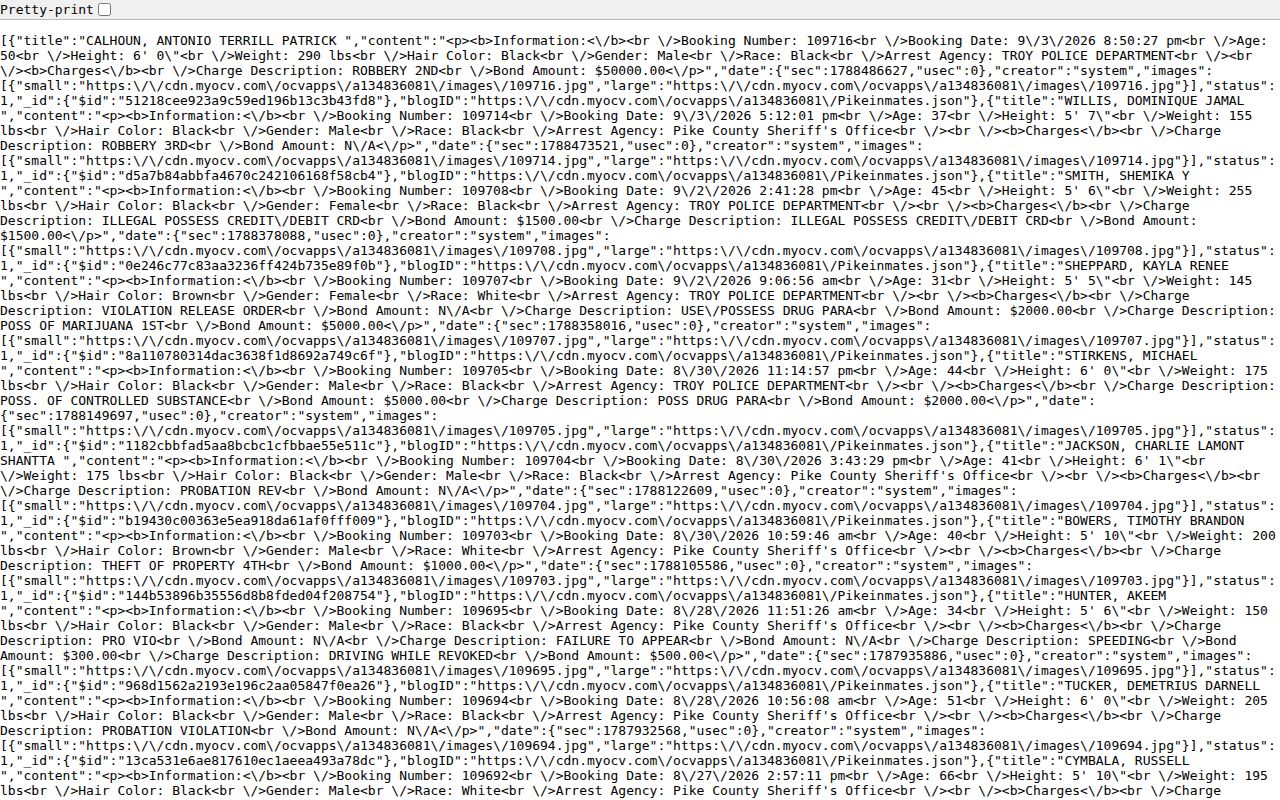
Old and new records can sit side by side. The date field on each entry matters more than the label on the page.
Pike County Weekend Booking Patterns
No official Pike County source claims that weekend arrests rise, promises Monday catch-up posts, or sets a holiday export schedule. A multi-day range still helps. Intake work and public posting do not always happen at the same moment, so someone arrested late at night may cross a calendar boundary before the booking card is complete. Transfers from a municipal jail can add another delay.
Troy shows why agency pathways matter. Local reporting has described a person processed at Troy City Jail and later transported to Pike County Jail. One event, two timestamps. That is not a universal procedure, but it explains why a city arrest date and a county booking time can differ. Search several dates around the event and keep both times.
Do not count visible cards as a crime trend. Roster depth, transfer practices, agency mix, releases, delayed entries, and corrections all shape what a date range holds. A trend claim needs a consistent statistical dataset, not a casual tally of booking images.
Pike County Arrest News Sources
Local news adds chronology and quoted agency statements. It is also episodic. WTVY's Pike County coverage carries public-safety stories and agency announcements that update as stories publish, not as any complete booking log. The Troy Messenger covers the county seat too, though it offers no freely searchable current arrest blotter. One caution on news pages. Story images may show scenes, officials, or suspects, and they should never be relabeled as booking photographs.
The WTVY county page shows this story-based landscape:
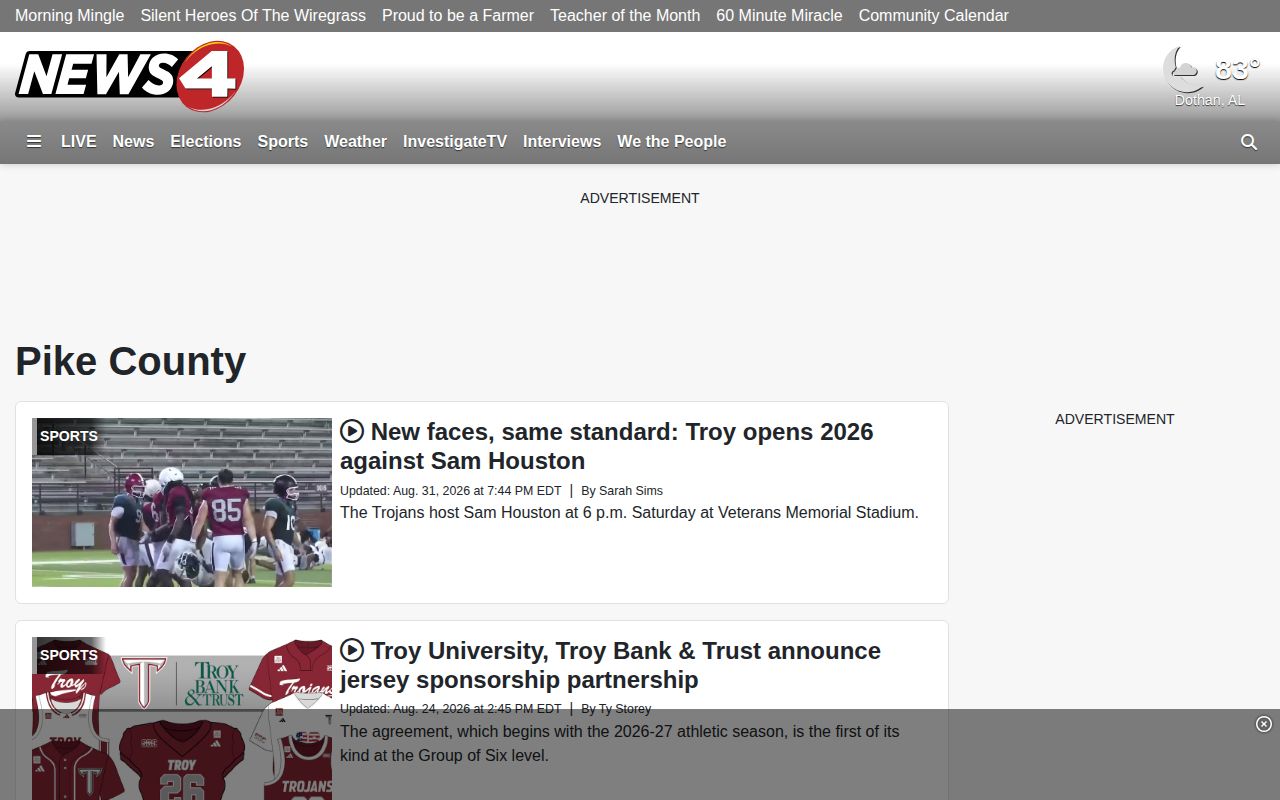
Dated news coverage adds context around a Pike County arrest. Check booking details with the Sheriff's office, and follow later outcomes through the court record.
The Wiregrass Daily News and Troy University's TrojanVision have each run stories on individual Troy arrests. A report may explain why officers acted or note when a transfer happened. They are not databases, though. Attribution matters, so keep phrases like "police said" attached to whatever the story claims about the arrest.
Unofficial Pike County Arrest Indexes
Third-party pages can keep copies after official pages change. They rank behind government sources every time. RecentlyBooked, Busted Newspaper, Arrests.org, and Mugshots Zone all carry Pike-local sections, with varying depth and photo presentation. None controls the Sheriff record, guarantees completeness, or reports the final court outcome.
The RecentlyBooked Pike section is one example of an unofficial county index:
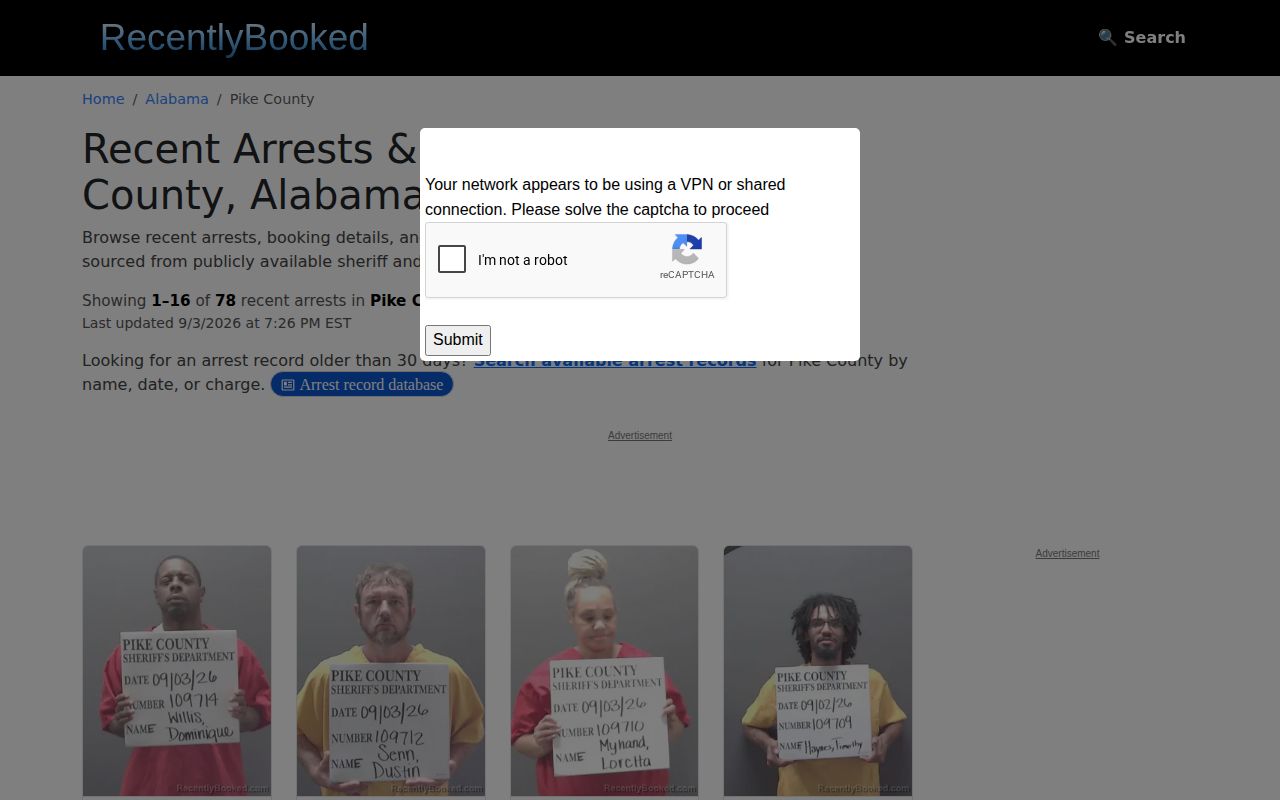
Treat any third-party page as a lead, not an authoritative roster or proof of present custody.
If an unofficial listing conflicts with the Sheriff's data, trust the official booking record for intake fields. Trust the court for the outcome. Never pay a service to decide whether a public record can be corrected or removed.
Pike Arrest Archives and Retention
Pike County keeps no posted rule for how long booking cards and photos stay on the roster. The Sheriff's office publishes no retention schedule, no destruction policy, and no archive timeline. So treat what you see as a live log, nothing more. An entry that vanishes may simply have rolled off the display, and one still listed may not mean the person is in custody today.
Need something older than the visible arrest log? Call 334-566-4347 and ask for the Pike County Sheriff records custodian. A good request names the person, the booking date, and a booking number if you have it, then asks for the booking card, arresting agency, charge and bond fields, release details, and any photo that can be released. One caution: official sources list two mailing addresses, 120 Church Street and 1318 N Three Notch Street in Troy, so confirm the correct one before sending anything.
What about destruction rules? Alabama local records fall under approved Records Disposition Authorities. The Alabama Department of Archives and History local-records guidance makes the point plainly: local officials cannot destroy records outside the authorized process. Ask the Sheriff which RDA covers jail booking records. Until that schedule is on the table, no one should guess at a number of years.
For old state-custody cases, the right tool is the ADAH incarceration collection, not the current Pike County jail log. Court files run on their own retention schedule too. The result is that booking, release, incident, and court records can each survive for different lengths of time in Pike County.
Pike Arrest Records Need Context
A single charge line on a Pike County arrest log is just one step in a longer process. Its story continues in release data, agency reports, and court files, so read the entry as a starting point rather than a finish line.
- Booking record
- The jail’s intake record for a custody event.
- Release record
- A record that custody ended or changed as shown by the holding system.
- Incident report
- The arresting agency’s narrative and related material.
- Disposition
- The court’s final or later action in the case.
Some Pike County material never appears in a public search at all. Juvenile cases, youthful-offender status, sealed files, and expunged records can all be restricted by law. If a name is missing, the cause may be legal or simply technical. The sensible order is the official arrest log first, then a release check, then the agency report, and finally the court outcome.
Trace the Pike Booking Timeline
Watching the Pike County roster across several days tells you less than you might hope. The Sheriff publishes no rule explaining when an entry moves, changes, or drops out of the display. Comparing yesterday's view with today's can show that something shifted, but not why. A release, a correction, a transfer, or a routine system update can each reshape the list.
The agency label on a booking card earns its keep on a weekend timeline. A Pike County Jail entry may credit Troy Police, Brundidge Police, ALEA, the Sheriff, or another agency, and that label points you to where an incident narrative would live. It does not mean the arrest happened at the jail. Nor does the booking time equal the time of the incident, so keep those two moments separate on your timeline.
Do not lean on the release export as a stand-in archive. It only shows whether the Sheriff's system carries a release-side entry, while the court file holds what became of the charge. When an old booking slips past the display window, request the dated record from the custodian rather than trusting an unofficial copy.